There’s a small marker on the roadside to indicate the exact spot of Dean’s crash if you know where to look for it, although most people pass right by it without noticing. This is fitting in a way, since Dean’s legacy isn’t really rooted in the exact circumstances of his death, nor is it based entirely on his screen career, which after all spanned just three roles. It could be argued that Dean’s legend is predominantly the byproduct of his embodiment of a certain negative perception of celebrity — the too-much-too-soon, live-fast-die-young credo which the public finds so compelling as a definition of the fruits of fame.
The counterbalance to that particular brand of screen immortality lives further north in Carmel — a picturesque village where tourists and townies vie for parking spaces on narrow roads, and ecological conservation is taken so seriously that every tree is reportedly registered individually with the local authorities. Clint Eastwood has called Carmel his home for close to four decades, and it is surely no coincidence that this particular screen icon — whose disaffection with the film industry’s standard operating procedures is demonstrated by the almost total autonomy he has maintained since ascending to superstar status in the late 1960s — has made his primary residence so far from the company town where his professional interests continue to thrive.
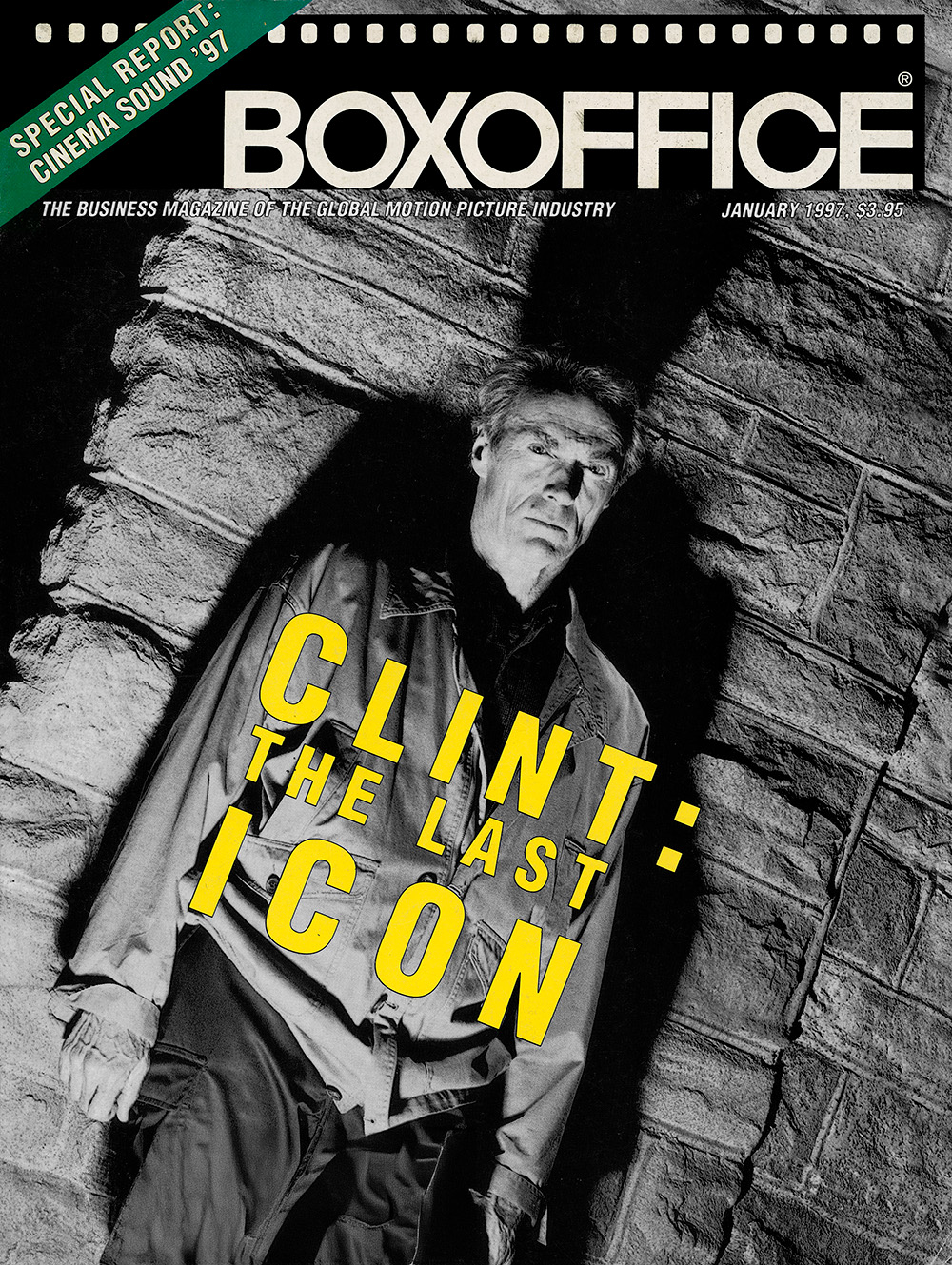
Eastwood’s star burns as brightly as any in Hollywood history — so brightly, in fact, that its sheen for many years obscured what may be his most enduring accomplishments as a filmmaker, especially in America, a country his best films, as both actor and director, have had so much to say about.
He has been world-famous for over 30 years — a superstar, remarkably resistant to the trends that elevate and bury screen careers with tidal regularity.
“I never appeared to have any anxieties, but you do [when you’re first starting out]. The challenge is not accompanied with any great anxieties now.”
But what makes Eastwood unique, and what has resulted in his relatively recent second ascension into the acknowledged front ranks of contemporary American filmmakers, isn’t the stardom he has worn so lightly for so long but the accrued accomplishments of a career that in retrospect managed to resist most of the customary temptations in pursuit of a more complicated agenda. The flame-out of an unfulfilled talent like Dean’s offers high tabloid drama, but Eastwood’s steady accumulation of achievements — many pulled off in spite of, rather than because of, his long reign as a bankable star — has made for a creative legacy that is that much more likely to endure.
Thanks to “Unforgiven,” the darkly revisionist western masterpiece that brought him Oscars for Best Picture and Best Director of 1992, it’s today a foregone conclusion that Eastwood is a serious and accomplished filmmaker. But it wasn’t always that way. Back in 1970, when Eastwood first decided to try his hand on the other side of the camera with a psychological thriller about a DJ and an obsessed fan entitled “Play Misty For Me,” his request was met with a combination of wariness and bemused tolerance at the executive level — treated as an act of benevolent indulgence offered to a rapidly rising star.
“I had signed a deal with Universal. So I went to the head of the studio, Lew Wasserman, and said ‘I’ve got this little story about a disc jockey in a small town who gets in a sort of psychotic love affair.’ And he said, ‘Well, that’s fine’ — but some of the execs didn’t feel that way, some of them felt that it was out of the genre that I was playing. And I said, ‘And also, I’d like to direct it.’ And he said, ‘That’s fine.’ Then he called my agent to one side, and he said, ‘Yeah, we want him to direct it, but we won’t pay him anything.’ I said, ‘I’ll pay them for the opportunity. I realize it’s a risk, but after I show ’em what I think I can show ’em, hopefully they’ll be encouraged to look kindly on this.’”
“Play Misty For Me” was correctly recognized as a departure for its star, who in 1971 was just coming off a career-defining first performance as Dirty Harry and who already had all three of his equally legendary Sergio Leone-directed “spaghetti westerns” behind him. But most commentators of the day focused on Eastwood’s visible desire to stretch as an actor, as did most opinion on “The Beguiled,” the eerie, darkly brilliant Civil War-era melodrama Eastwood starred in for “Dirty Harry” director Don Siegel that same year. As with many of the risks Eastwood took in the early phases of his superstardom, the full implications of what he was up to were largely missed, for with “Play Misty For Me,” an incremental process had begun.
“One thing led to another, I started continuing on, occasionally doing one, and not directing others. But every other one or every third one I’d do, and eventually here you are in ’96, [having directed] 20 films.”
It is the promotion of the latest of these directorial efforts, the political thriller “Absolute Power,” that has brought Eastwood down from his home in the hills above Carmel to the conference room of the Mission Ranch — the unassuming hotel-restaurant complex Eastwood purchased in 1986 because it was in danger of being razed and he remembered it fondly from his days as a military trainee at nearby Fort Ord back in 1951.
It must have been with reluctance that Eastwood left hearth and home. His wife of one year, Dina Ruiz, is eight and a half months pregnant on this rainy November day, and Eastwood mentions in passing that his 88-year-old mother Ruth is feeling under the weather as well.
But Eastwood, who comes off in person as plain-spoken and even courtly despite his many achievements, is also a very driven filmmaker, and perhaps Hollywood’s quietest empire builder. A recent British biography went so far as to claim that films produced by Malpaso, the production company Eastwood formed to make “Hang ’Em High” back in 1968 and which he has run out of the Warner lot since 1976, account for “an astonishing 20 percent of Warner Bros. lifetime corporate turnover.” Product is coming to market, and it is a notable facet of his personality that Clint Eastwood has always had a healthy respect for the promotional imperatives of product — especially product that he not only stars in, but has chosen to direct.
Based on the bestseller by David Baldacci, “Absolute Power” is a Cadillac project, with a screenplay adaptation by William Goldman and a cast including Eastwood, his “Unforgiven” co-star Gene Hackman, and “Husbands and Wives” Oscar nominee Judy Davis. A Castle Rock release, “Power” is almost sure to stir up some political controversy, dealing as it does with the uncomfortably contemporary dilemma of a philandering U.S. president whose character deficiencies result in high crimes and misdemeanors which threaten to bring the whole government down.
As this conversation takes place, less than two weeks have passed since Bill Clinton’s re-election after a campaign in which the issue of presidential character played a predictably prominent role. The timeliness of “Absolute Power” offers a fairly radical departure for Eastwood from such recent efforts as the romantic “Bridges of Madison County” or the rural policier “A Perfect World.” Even director Wolfgang Petersen’s “In the Line of Fire,” which put Eastwood on the trail of a would-be presidential assassin, offered few points of purchase for op-ed analysis; its themes of guilt and expiation were closer in spirit to “Unforgiven” than to anything currently under discussion in the pages of the Washington Post.
When the subject of “Absolute Power’s” topicality is broached, a wide smile plays across Eastwood’s lips. But he hastens to say that no specific political references are intended or implied.
“It’s not meant to emulate any particular politician. True that this president is philandering a little bit, but that’s probably happened a lot of times in history. He doesn’t resemble anybody that we know currently on the scene, he’s just a guy who is where he shouldn’t be.”
Given Hackman’s potent ability to convey both charm and malevolence simultaneously, it still seems likely that audiences will, at least subliminally, project some of their darker fears about government onto “Absolute Power.”
“Well they might. People are always suspicious, I think mainly because we’ve seen some flawed politicians in recent years, and also the press is very vehement about exploiting that now. We’re living in sort of a tabloidesque age, because politicians are the product of television now, more than they used to be. They’ve become like television actors who are all of a sudden vulnerable to the same kind of speculation.
“Personally, if a person does the job well, I think that’s probably what they should be judged upon. What does a president or any politician in this country owe us? They owe us to do the best job, and to live up to the faith we put in them by voting them in. In the old days, you didn’t have to be a television star, but now you have to have a certain television charisma to get by. The era of the best person winning… I don’t know if it was ever here. Who knows? But there’s more to it now than just qualifications.”
If a few incidental parallels to current events mark “Absolute Power” as an exceptional effort in Eastwood’s recent oeuvre, its production reflected the continuation of several significant hallmarks of his work as a director. In addition to Hackman’s fresh pairing with the director who helped him garner a Best Supporting Actor Oscar for his work in “Unforgiven,” “Absolute Power” reunited Eastwood with many of the technicians whose talents he’s been utilizing for years.
His relationship with “Absolute Power” cinematographer Jack N. Green is emblematic of the way Eastwood tends to stick with people he works well with. Green, who began his career working as a camera operator for Eastwood’s other favorite cinematographer Bruce Surtees, graduated to interim director of photography when Surtees fell ill during one Eastwood production. With Surtees’ encouragement, Eastwood “promoted” Green to director of photography beginning with “Heartbreak Ridge” in 1986. With the exception of the Eastwood-produced “The Stars Fell on Henrietta,” shot by Surtees, Green has lensed every Eastwood/Malpaso project made since.
“I can talk shorthand to him. He brings a lot of ideas to the table, and I encourage that with every single member of the crew. I say, ‘Don’t be afraid to express yourself. Because you’re not doing any good if you’re just putting a bolt in and tightening it up on the other end. If there’s a better way to put the bolt in, a faster way to tighten it, or a more efficient way to operate, by all means, tell me.’”
On some sets, such openness might be seen as an invitation to production slowdowns and a breakdown of the chain of command. But not so with Eastwood, who is something of a legend within the industry for the frugality and decisiveness of his shooting methods. It’s a skill he learned from his television work as an actor on the old “Rawhide” series, and from his five collaborations with the late Don Siegel — perhaps the most significant professional association of Eastwood’s long career.
“Don was very prolific. Don could pull together a movie really fast. If he had the script and he liked the script, he was right off and running.”
Like Siegel, Eastwood shoots lean and brings his films in on time and under budget as a matter of principle. With “Absolute Power,” Eastwood outdid himself; the film came in a full 17 days earlier than its schedule said it would — in part because of Eastwood’s sense of his cast and crew as creative equals, whose time is as valuable as his own.
“Crews get a sense if you’re screwing around. They get a sense if you’re lost, and they get a sense if you’re just dilly-dallying. They’ll bear with you, through take after take, if they feel that you’re trying desperately to get something that isn’t quite happening. But they fade on you if they see you’re just wasting time — and justifiably so.”
Piece of cake: Celebrating another efficient Eastwood shoot at the wrap for “Absolute Power.”
Fastidious as his directing may be, Eastwood’s career has been characterized by anything but the taking of safe bets. While he has consistently attended to his superstar status, all five “Dirty Harry” projects could be viewed in this light, he has just as consistently subverted it, tackling highbrow themes and an enormous range of characters that the critics who decried as pointlessly sadistic his career-making “spaghetti westerns” with Leone would never have predicted for him.
Meanwhile, the Leone films — “A Fistful of Dollars,” “For a Few Dollars More” and “The Good, the Bad and the Ugly” — have come in for their own share of revisionism, so that it’s now a critical given that Eastwood’s career as a leading man started with three masterpieces in a row.
When Eastwood talks about the projects he’s proudest of, they are almost always the ones that stretched him as actor or director, and almost never the ones that grabbed the biggest grosses — except in those instances, as with “Unforgiven,” which made over $100 million domestically, where those two priorities dovetailed into one another.
“You make a film, hoping that somebody wants to see it. You certainly don’t make it for a lot of empty seats in a theatre. But I had a line in ‘White Hunter, Black Heart’ where the [movie director] I was playing is criticizing the writer, and he says, ‘You should forget anybody’s ever gonna see a film when you’re making it.’ And you know, there’s something to that. Yeah, you hope that a reviewer’d like it, just the same as you hope everyone else does. Nobody wants to have somebody going out of the theatre going, ‘Oh boy, that was a yawner,’ but that happens, that’s just the way it goes. Some of my best films were the least attended, in my mind.”
Eastwood has an almost paternal fondness for some of his shaggier, more image-busting efforts, such as the depression-era drama “Honkytonk Man” and the rodeo comedy “Bronco Billy.” “Every Which Way But Loose,” the screwball comedy in which Clint lost the girl but rode off into the sunset with an orangutan, was a film that particularly delighted him, not least because it became an unexpected boxoffice smash despite the studio’s distinct lack of faith in it.
“The studio would have sold it for 10 cents on the dollar before it was released. All their… ‘Research’… said the picture wasn’t going to work.”
At least two of the many movies he has directed and starred in seem to hold particularly special places in Eastwood’s heart: “Unforgiven,” a film he clearly would have loved even if it never made a dime, and the picaresque 1976 western “The Outlaw Josey Wales” — a ruminative, character-driven epic that stands as perhaps his first fully realized directorial effort, and the film which he credits with beginning the decades-long process of his filmmaking finally emerging from the long shadow cast by his status as a boxoffice star.
“I think maybe it started turning in the ’70s, with ‘The Outlaw Josey Wales,’ which I think is a movie that stands up today. If that came out on the market today, I think it would be appreciated, maybe even more than it was then, because maybe there was too much prejudice [back then] against the genre, or the person making it.”
In fact, in looking over Eastwood’s many credits, what emerges is something almost no one would have imagined him capable of when “Play Misty For Me” first entered the marketplace back in 1971. Given his willingness to embellish and violate his screen persona, what Eastwood has created, in his art and in his life, is nothing less than a multi-leveled rumination on the American concept of heroism, and on what it means to be an American star.
That’s a high-toned argument which Eastwood might resist endorsing, though it is interesting to note he is quite emphatic about his hope that, when the time comes to tally up his achievements, he’ll be remembered more as a filmmaker than as a star. Hardly one to wallow in nostalgia, it will be enough for him if the history books recognize “just the fact that he made some films that were important, or that they somehow fit into the scheme of film history. And I hope to do some more.”
In the meantime, there’s “Absolute Power” and whatever else the future may bring to a man who, creatively and personally, views the present as the prime of his life. He lives for the moment, and this particular moment is especially right for him.
“After ‘Bridges of Madison County,’ I took a year off from work. I felt fine. I had a good time, I contemplated a lot of things, worked on my personal life a little. Took time out to do some things that I maybe felt I should have, that you neglect when you’re younger and you’re striving to get things going.
“There’s that thing actors go through in their early stages, where they say, ‘This is my last job.’ So another job comes up, pretty soon you’re accepting [all of] them. I used to accept them back to back, and I see young actors now doing that — accepting work, back to back to back. It’s that thing where you’ve got the brass ring, you feel like you’ve got to keep riding it, stay on the merry-go-round. But at some point, you realize it’s not necessary. You’ve got sort of a history.
“There’s always something new, a new challenge, which makes it fun. But the challenge is not accompanied with any great anxieties now. I never appeared to have any anxieties, that’s not my appearance, but you do [when you’re first starting out]. You get the brass ring, and you go start grinding, and if they want you, you keep grinding. Maybe that’s a point in life when you feel you should do that, because you’re afraid that maybe two or three films, and maybe you’ll be selling used cars somewhere. But then after awhile, you build up your chops.”
“Absolute Power.” Starring Clint Eastwood, Gene Hackman and Judy Davis. Directed by Clint Eastwood. Produced by Clint Eastwood and Karen Spiegel. Screenplay by William Goldman, based on the novel by David Baldacci. A Malpaso Production. A Columbia Release. Feb. 7.