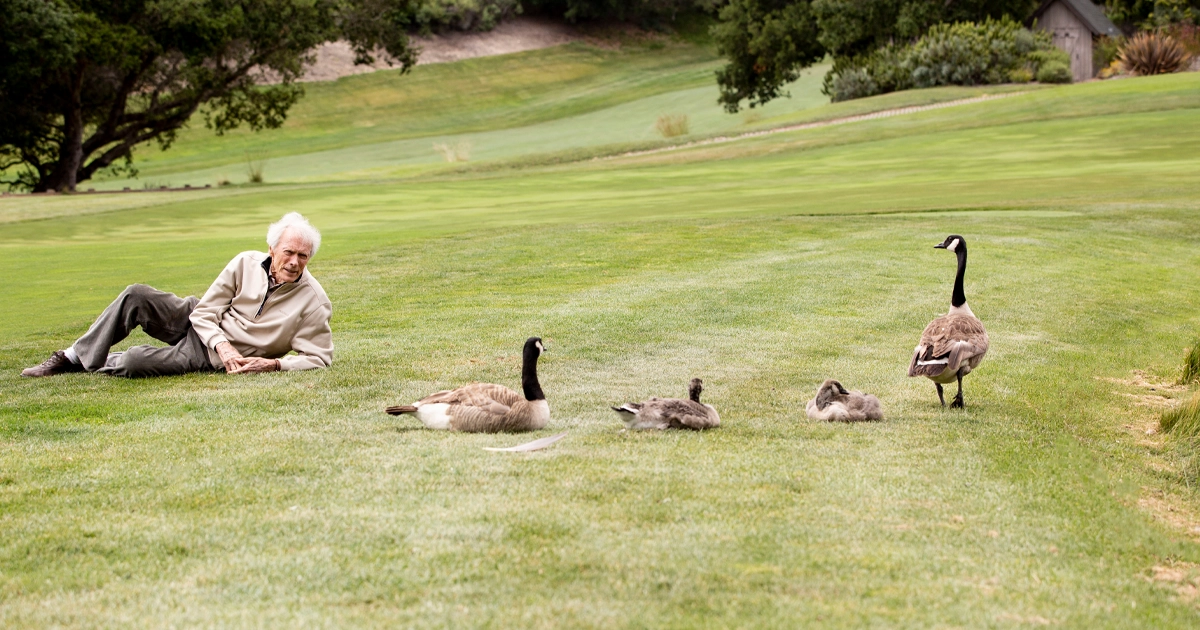
Turkeys are another favorite. We pass a flock feeding by the golf course near some blacktail deer. “They’re breeding right now,” Eastwood says. “You see a lot of big flocks. The females are nesting. The males are strutting, looking good. That’s all they have to do. Stand around and look good.”
The same energy and creativity that led to the creation of Academy Award-winning Malpaso Productions such as The Unforgiven and Million Dollar Baby is on full display at Tehama. Only this time, instead of partnering with Warner Bros. or Kennedy/Marshall, Eastwood has teamed up with Mother Nature.
The Key Man
The other element to his success is a longtime collaboration with architect Alan Williams. The two first met when Eastwood was elected mayor of Carmel-by-the-Sea in 1986. Initially, Williams advised His Honor on matters related to the municipal water system.
Then came the 1986 acquisition of the historic Mission Ranch. Williams roars with laughter as he recalls how run-down the century-old farm had become. The prior ownership group hadn’t invested a dime. They fully expected it to be razed and replaced with condominiums.
“Duct tape and baling wire — that’s what held the place together,” Williams tells me during a lunch we share with Eastwood in May.
“It was a repair job,” Eastwood says. “Most people wouldn’t have done it the way we fixed it up. They would have said they couldn’t do it and had it torn down. But everybody felt the same way about keeping things looking the way they had always been.”
Williams and his Carmel Development Company proved their mettle with the successful renovation of the dilapidated landholding. Since then, he and Eastwood have worked together on countless ventures in Carmel-by-the-Sea and on the land.
In the process, the two have facilitated the preservation of thousands of acres of Monterey County in perpetuity. In many instances, they purposely extinguished or diminished coveted development rights on tracts of land large and small.
Saving Odello Farm
Eastwood’s 1995 acquisition of the 134-acre Odello Farm is a paramount example. Situated near the mouth of the Carmel River alongside Highway 1, the Odellos’ historic farm benefitted from a strategic location, valuable development rights, and considerable water rights. More than 80 homes were permitted for construction on the bucolic artichoke farm.
Eastwood subsequently gifted Odello Farm, its development rights, and water rights to the Big Sur Land Trust and to Monterey County. He also made water available to the community. Odello Farm ultimately proved to be the missing piece of the puzzle in a countywide trail system that now connects Carmel Valley to Big Sur.
The Pebble Beach Company
And, of course, there was the 1999 acquisition of Pebble Beach from its Japanese owners by a partnership that included Eastwood, golf legend Arnold Palmer, former Major League Baseball commissioner Peter Ueberroth, and former United Airlines chief executive Richard Ferris, among others. Long story short, Eastwood and Williams have covered a lot of ground together. And they’ve enhanced that ground. And in many instances, they’ve preserved it.
In scope and complexity, Tehama stands out as their masterwork. “It just depends on what you’re in it for,” Eastwood says. “We were in it because we both knew we were going to live here.”
To his point, both Eastwood and Williams built homes at Tehama. It’s where they live full-time. The prep work was anything but hurried. The two spent years scouting its ridges, its valleys, and its rolling hills: Eastwood, on foot, and Williams, behind the wheel of an old red GMC Jimmy.
Williams uses an interesting phrase to describe this multi-decade process: “We eased our way into it.” Time-tested ranch roads were respected and enhanced. Wildlife corridors and other natural features were left as-is.
“We didn’t want to step on any toes,” Williams says.
Preserving Tehama
Together, they endeavored to celebrate Tehama by minimizing man’s footprint. The property was permitted for full-scale development, including hundreds of homes. Thanks to Eastwood’s day job, however, he was able to forsake this more lucrative payday.
Ultimately, more than 85 percent of Tehama’s 2,040 acres were set aside as natural open space. The infrastructure, amenities, and 90 homesites account for roughly 300 acres. Two-thirds of the homesites have sold; some 30 remain. Rick Ojeda, the Estates Director for Compass Real Estate in Los Angeles, has the listing on the estates, which start at $1.5 million and range in size from 5 acres to more than 24 acres.
A final collaborator merits mention: Jay Morrish (1936–2015). Eastwood and Williams tip their hats to Tehama’s gifted golf course architect. “Jay got it,” Eastwood says. “As soon as he told me, ‘The big thing is not to screw this place up,’ I knew we had our man.”
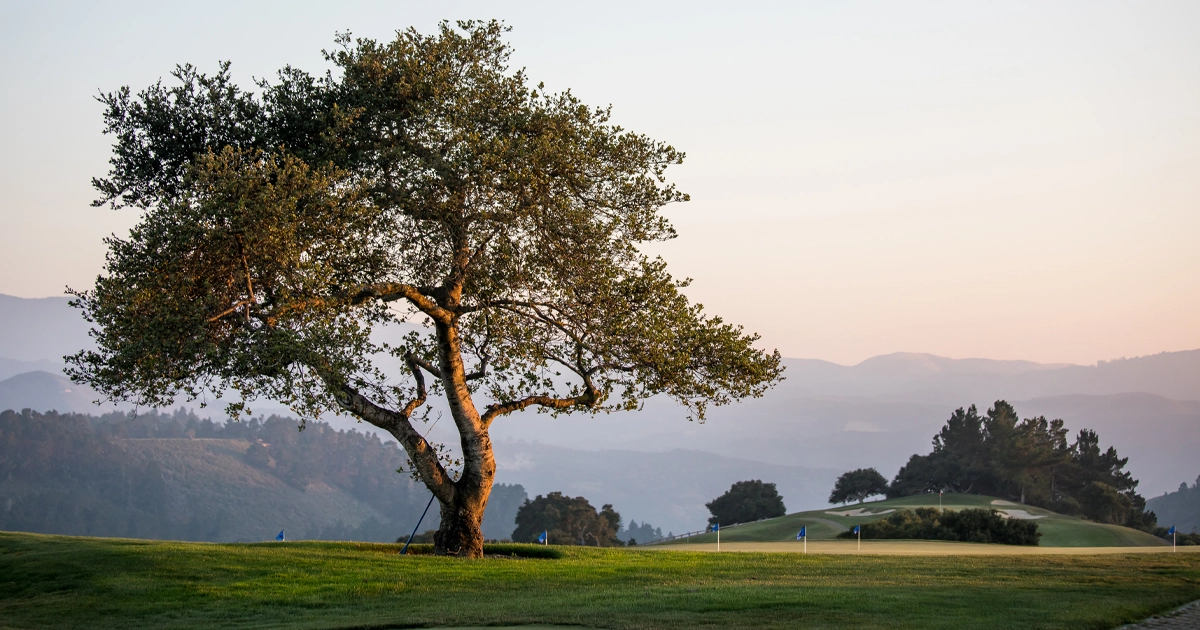
Whether it’s the wildlife, the views, or the game of golf itself, the 6,506-yard championship course brings Eastwood endless enjoyment. As he guides the Super Cart through the trees, our conversation shifts to life way back when.
“During the Depression, my parents had to move all the time because the jobs panned out. My dad would get a job, and then two weeks later, the company went belly up. He’d get a new job, and we had to move. We lived in Southern California, in Sacramento twice. I lived in Redding. I lived in the Bay area — in Hayward, in Niles, in Oakland, San Francisco, everywhere,” he says.
I get pointers in customer service from the former Tribune paperboy. Eastwood recalls the big bold type that screamed “WAR!” on the front page of all the dailies after the attack on Pearl Harbor. He laments the loss of the wharves and the ports and the industrial heft that gave the Bay Area its global swagger. The cities he knew have long been replaced by high-tech hubs.
Eastwood brings the Super Cart to a full stop and looks out at the hills that ring this sanctuary that he has created.
“This won’t change. Ever.”