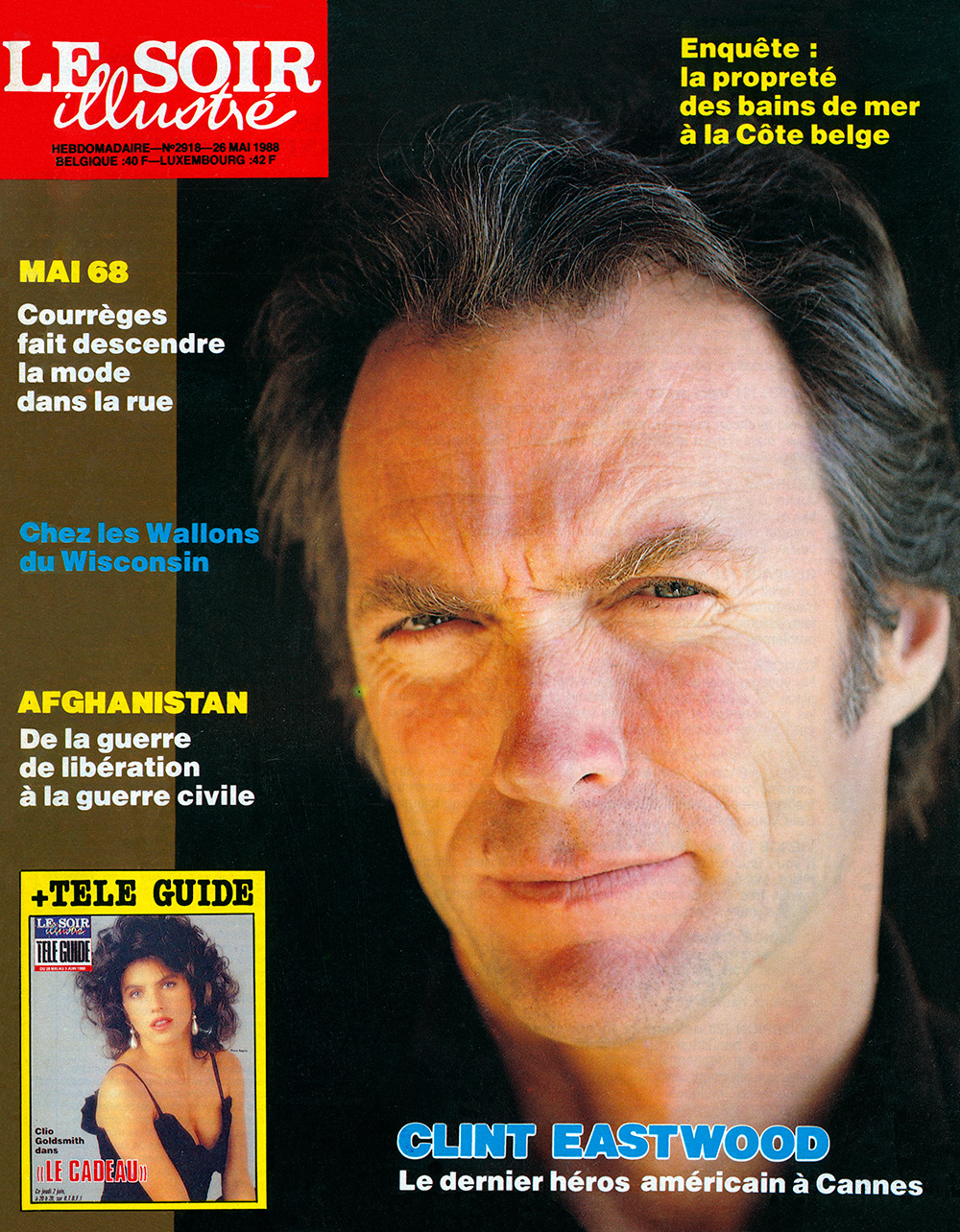
The steel cowboy, shaken by the music of Charlie Parker, has put his Magnum away in the locker room.
A pause for a beautiful film, Bird. His former supporters want him as president, and Dirty Harry
may return for the fifth time within months.
Jazz and westerns are the two obsessions of America’s “big children”. After having drunk deeply from plains full of horsemen, cattle, bullets and beefy comedy, the spiritual son of John Wayne decided to rummage through the second cradle of his country — even at the risk of losing a few feathers.
The richest “animals” in the zoo-office — cinema, video and television — made him, for two years, the star who brings in the most dollars: “authentic” in the United States, where anything and everything can be printed, and where he was awarded that title in 1985.
Clint Eastwood has therefore made a film about saxophonist Charlie Parker. Black, drug-addicted, alcoholic, loser, genius. What is it that modern-justice Clint has been able to find in this wrecked man to make him the hero of his thirteenth film as director?
He is a man who knew how to preserve his marvellous little-boy side while progressing in his art and developing his genius as a musician. He lived at two hundred miles an hour.
The post-war “boppers”, of whom Charlie Parker was the soul, shot themselves up to find inspiration. Rebels, waifs, introverts, communicating only through music, they inspired Eastwood more than the material for a conventional film.
His childhood was steeped in jazz, between Fats Waller, his mother’s idol, and the evening parties hosted by musicians in the San Francisco clubs where his father thumped away on an old piano.
Not really a first-rate musician himself, Clint nevertheless ran a record label: country music. “Viva Records”. No doubt he never understood that country was for whites and jazz for blacks. That did not stop him from owning Parker’s entire discography, for whom he developed a true passion after seeing him on stage.
In 1945, with Lester Young and Hank Jones, the alto saxophonist became the most brilliant musician in jazz history, a genius of improvisation and uncontrollable rhythm. He was to die in 1955, at the age of thirty-four.
Clint was less than twenty at the time and was already in the Universal Studios’ employees’ files. He loved Parker, but liked to imagine that he, too, might one day make a film about him.
At that time, his preoccupation was not yet to find a shooting script — “I dream about it” — and in the late fifties, when television gave him his chance by putting a Stetson on his skull, he would never take it off again.
Clint Eastwood welcomes Jean Grace, newly elected mayor of Carmel.
In Rawhide, the long-running successful series, it was he who, in the middle of a herd of cows, became the star.
Sergio Leone and a fistful of dollars consolidated the cliché of the authentic cowboy who “kills without hatred and dies without regret”. The western saga made him a future idol of conservative America, while progressive America preferred Redford — first, then silver, then experience.
I learned everything. To walk. To talk. To keep quiet. To refine my reflexes and fix my gaze like that of a snake.
And he learned well. That glacial detachment and nonchalant air would no longer serve only the actor. When director Don Siegel transformed him into Inspector Harry Callahan — Inspector Harry in 1972, “the scavenger” and its sequels, Magnum Force in 1973, The Enforcer in 1977 and Sudden Impact in 1983 — each film was a disaster at the box office.
He abandoned the horse for the Mustang on every possible occasion, changed the model of revolver, stopped wearing his hat, but his Stetson continued to fling his muteness and his constant air of indifference into everyone’s face. To survive, Clint learned to keep quiet.
Clint Eastwood with the two principal actors from his film Bird: Forest Whitaker, in the role of Charlie Parker on saxophone, and Sam Wright as Dizzy Gillespie on trumpet.
America became inflamed over the case of the “Dirty Harry” films. Some saw nothing but a pernicious film and called for a boycott; others recognised in him a muscular response to the wave of violence and banditry that was sweeping through society. A futile debate.
Today, the man is respected by everyone. He has become a university subject. Film libraries programme his films. Festivals supplicate him. The studios — from stagehands to technicians — never tire of praising the man: the director, the producer, the actor. Generous, delicate, professional, elegant, economical, fast, refined. Class, in short.
He is sparing with comments and content with a quiet little life. First with Maggie, who gave him two children, and from whom he later divorced after fifteen years of household life and gossip. Then with Sondra Locke, his favourite partner on screen.
He has lived for sixteen years in a small Californian town of 4,709 inhabitants and has no desire to live anywhere else. Carmel, California. A restored inn, a celebrated jazz bar — “The Hogs Breath Inn”. One speciality is the scrambled eggs named after Clint Eastwood: eggs, cottage cheese and cream.
As mayor, always wary of big ideas and municipal interference, he summed up his programme as follows:
Fight against interference in the life of the citizens. Run the municipality like a business. Stick to my decisions.
Although he did not stand again in the local elections and, unlike his colleague Redford, does not seek Reagan’s seat, former officials continue to celebrate him and proudly wear T-shirts bearing the inscription: “Eastwood for President”.
I am the moderate, individualist, liberal Californian type when it concerns citizens’ rights, conservative when it comes to administering their property. I admire de Gaulle, Roosevelt and Churchill. I hate drugs and prostitution. Money? I have some. National political career and power therefore do not interest me.
The man has chosen. Even if “a film will never change the face of the world”, he believes more in what happens on a screen than in political meetings.
I have always followed my instinct. And the advice of three men.
Sergio Leone taught him how to play. From Don Siegel, he owes two of his finest roles and the fact that he became a director and producer. From his father, he inherited “a sense of measure, economy and work well done and well earned”.
The teaching has borne fruit. Clint Eastwood has never sacrificed fashion to budget or schedule overruns. It is said that he forbids even the smallest chair on his sets, so that no one may relax and everyone shows tireless diligence at work.
And, in Carmel, people speak of his term as mayor with the greatest respect. It is true that, on leaving office, he donated 5.5 million dollars to the town. To remove from the claws of dreadful property developers a historic ranch… Redford, again, would not have done better.
Exit politics, then. What remains is the western and jazz. Dirty Harry, the steel cowboy, is shaken by Charlie Parker’s music. First steps: he insists to Warner that it produce Round Midnight, Bertrand Tavernier’s film.
The training continues: he sponsors the distribution of Last of the Blue Devils, an anthology jam session bringing Parker and Dizzy Gillespie together. Finally, he launches into Bird. The great leap, last Saturday at Cannes, caused general enthusiasm.
Sweet Clint has nailed Dirty Harry’s mouth shut — time enough to swing a good blow.
Colt against sax. Clint had already exchanged his gun for a guitar in a scorned and misunderstood film: Honkytonk Man. A financial flop but a real source of satisfaction for Eastwood.
He had grown tired of pleasing people but, no fool, immediately replenished his supplies with Sudden Impact, the fourth instalment in Inspector Callahan’s adventures.
This time again, the vigilante of modern America intends to save him from bankruptcy — the bankruptcy of Malpaso, his production company, and the bankruptcy of his reputation. Because when one holds on to a hero, one does not always like to see him swaying in another world.
In case Clint feels closer to Europeans, The Dead Pool must be released without delay. The last of the giants is no dwarf in business.