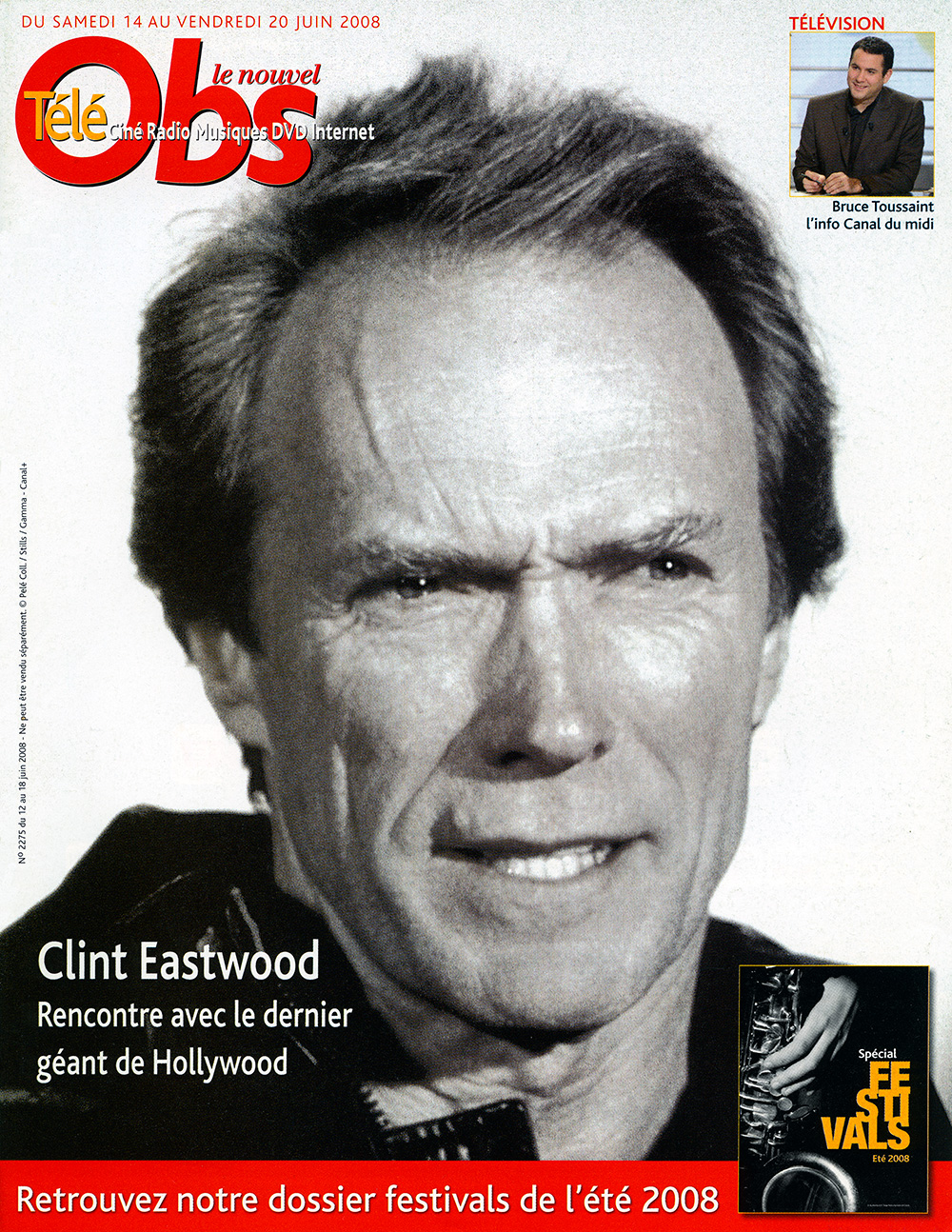
While his latest directorial feature, Changeling, was praised by critics on the Croisette,
the five films of the Inspector Harry saga — which marked the birth of the anti-hero in cinema —
are being reissued on DVD. Another opportunity to celebrate
Clint Eastwood, tireless actor and director.
CINÉMA à l’affiche
It is one of the most famous police officers in cinema history. Better still: a pop-culture icon.
His brutal methods made the respectable critics howl with outrage, but his lines became legendary: “So, do you feel lucky, punk?”
In 1971, with Dirty Harry, Clint Eastwood and director Don Siegel revolutionised the detective genre,
proving that a hero did not need to be “on the right side” to attract audiences.
This justice-seeking vigilante, violent but guided by a clear sense of good and evil —
this “Dirty Harry” — quickly became more than just another role for Eastwood,
who preferred letting his .44 Magnum speak for him.
Less hunter than exterminating angel, he resembled the criminals he tracked down almost as much as the badge he wore.
It was no coincidence that the term “anti-hero” was used for the first time in relation to Inspector Harry.
An enormous box-office success, the film generated four sequels and transformed Clint Eastwood
into a global superstar, despite his reputation as a hard-line conservative.
At Cannes, Eastwood was not only presenting his new film, Changeling, starring Angelina Jolie as a mother searching for her missing son:
he was also promoting the Dirty Harry saga, which was receiving a deluxe DVD reissue.
Before attending the premiere of You Must Remember This,
the documentary about his friend Richard Schickel and the history of Warner Bros.,
for which he provided narration, Eastwood agreed to speak exclusively with TéléObs about the character who made him famous: Dirty Harry Callahan.
TéléObs — How did you get the role of Inspector Harry?
Clint Eastwood —
I very nearly didn’t make the film. Frank Wells at Warner Bros. offered me the role,
but I wasn’t immediately available because I was preparing to direct my first film, Play Misty for Me, in 1970.
Wells told me: “After that, you absolutely must make this film, because I’ve just wrapped it in five weeks.”
Then, when I was in post-production, Wells called me back.
He explained that after discussions with Robert Mitchum and Steve McQueen,
he had also spoken to Frank Sinatra.
I said: “Great, where’s the problem?”
They told me: “The problem is that Frank injured his hand. He’s out.”
So I said: “That still interests me.”
When they asked who I wanted to direct it, I suggested Don Siegel,
with whom I had just finished The Beguiled.
Did you ever consider directing the film yourself?
No, because I had just finished Play Misty for Me
and I didn’t see myself immediately taking on another production.
What attracted you to Inspector Harry?
His rebellious side.
This man wanted to fight crime, but he did so in an extremely radical way.
Critics at the time were horrified by his excessive methods.
Pauline Kael in the New Yorker even described the film as “a fascist attack on left-wing values.”
Were you surprised by the controversy?
Yes… I expected the film to provoke debate because the police officer
was every bit as violent as the criminals he pursued.
He fought fire with fire, if you like.
But to call the film fascist?
For me, Harry was simply an angry man fighting against a system he considered corrupt and ineffective.
“Dirty Harry”, simply an angry man fighting against a system he considered corrupt and ineffective.
Faced with soaring crime rates, trapped by bureaucracy and weakened by political compromise,
he eventually behaved in an extreme way.
In reality, Harry Callahan was a direct product of America in the early 1970s:
Vietnam, Watergate, the rise of serial killers…
It was also an era in which the political establishment seemed more concerned
with protecting the rights of criminals than those of victims.
In the famous “Miranda vs Arizona” case, the Supreme Court ruled that police officers
were required to inform suspects of their right to a lawyer and their right to remain silent.
At the same time, more and more people were asking: “What about the rights of the victims?”
I think that’s why audiences sympathised with Harry.
But for Don Siegel and me, this was simply intended to be a good thriller.
With Don Siegel, we were convinced we were making nothing more than a solid police film.
The character earned you a reputation as a hard-right conservative.
Today, after Million Dollar Baby and its euthanasia scene,
or Flags of Our Fathers and its anti-war message during the Iraq conflict,
people now see you as politically left-wing…
I believe people should be left alone to live however they choose,
as long as they don’t interfere with others.
That’s humanity’s great problem:
instead of judging others and telling them how to live,
people would do better to sweep their own doorstep first.
Critics may have objected to Inspector Harry,
but audiences made him a triumph. You were already a western star thanks to Sergio Leone,
but this film marked a turning point in your career…
That’s true. I was forty years old.
The film became a real phenomenon.
People adopted certain lines from it.
Naturally, we made sequels.
Warner Bros. was delighted.
You remained loyal to Warner Bros. throughout all those years…
Yes. When I made Dirty Harry with them,
I was still under contract at Universal and stayed there a few more years.
It wasn’t until 1976, with The Outlaw Josey Wales,
that I finally joined Warner for good.
I told them:
“Here is the western I want to make,
and I’m prepared to move my production offices here if you agree.”
Thirty years later, I’m still there.
I have a genuine affection for that studio.
That said, I’m not contractually tied to anyone.
If another studio offers me a good story,
I’ll make the film there. Changeling, for example, was a Universal production.
What attracted you to Changeling?
A mother sees her only son disappear.
Since the police investigation isn’t progressing quickly enough,
another child is eventually returned to her —
a boy who clearly is not her son —
and the police refuse to admit their mistake.
It’s a true story, even though it’s difficult to believe.
I’m especially sensitive to stories involving crimes against children,
and that dimension of the film interested me greatly.
Do you ever rewatch your own films?
Rarely.
But I did recently rewatch Dirty Harry.
My wife had never seen it, and her colleagues were teasing her about it,
so I showed it to her.
I think she liked it.
In any case, she didn’t ask for a divorce afterwards.